ForceBeyond Logo
Titanium aerospace jet engine undergoing a high-performance ground test with active exhaust

Closed Die Forging: Near-Net Shape Precision & High-Volume Production

Closed Die Forging: Near-Net Shape Precision & High-Volume Production

ForceBeyond is a premier global supplier of high-precision closed die forging (also known as impression die forging). By compressing hot metal between custom-engineered, hardened steel dies, we produce complex, near-net-shape components with unparalleled structural integrity and mechanical strength.

Our closed die forging capabilities support high-volume production runs for the world’s most demanding industries, including aerospace, automotive, energy, and heavy machinery. From lightweight aluminum and titanium to high-temperature superalloys like Inconel 718, we deliver fully machined, lot-traceable forged components that are engineered to withstand extreme stress, impact, and fatigue.

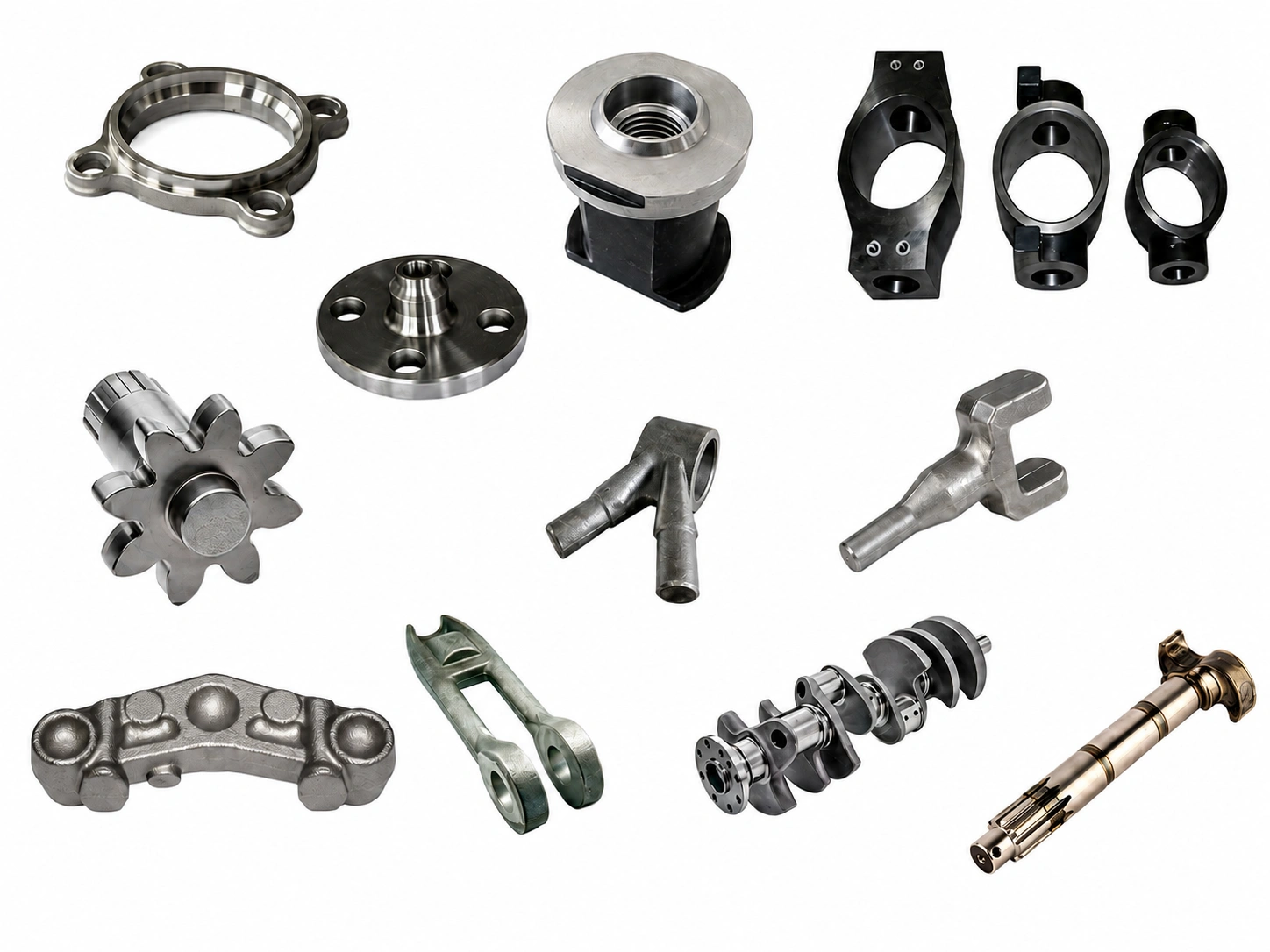
Custom hot-forged and precision-machined metal components, including flanges, shafts, brackets, gears, and crankshaft parts, on a white background.

Technical Capabilities: Closed Die Forging Materials

ForceBeyond has the metallurgical expertise and press capacity to forge a wide spectrum of industrial metals. Our closed die process optimizes the internal grain structure of these alloys, aligning the metal fibers with the contours of the component for maximum strength.

Material Category Common Alloys Forged Key Features & Optimal Applications
Carbon & Alloy Steels 1020, 1045, 4140, 4340 High strength and toughness. Ideal for automotive drivetrains, gears, and structural brackets.
Stainless Steel 304, 316, 17-4 PH, Duplex Excellent corrosion resistance and hygiene. Used in fluid control, medical, and marine applications.
Titanium Ti-6Al-4V (Grade 5) Exceptional strength-to-weight ratio. Mission-critical for aerospace airframes and turbine components.
Superalloys Inconel 718, Inconel 625 Extreme heat and fatigue resistance. Built for aerospace jet engines and nuclear power infrastructure.
Non-Ferrous Aluminum (6061, 7075), ECO BRASS Lightweight or highly conductive. Widely used in plumbing, commercial aviation, and EV manufacturing.

Why Partner with ForceBeyond for Closed Die Forging?

Procuring high-volume forged parts requires a manufacturing partner with advanced tooling capabilities, rigorous quality control, and scalable production capacity.

  • Optimized Grain Flow:Unlike machining from solid bar stock, closed die forging naturally directs the metal's grain flow to follow the shape of the part. This results in superior directional strength, impact resistance, and fatigue life.
  • Near-Net Shape Efficiency:Our custom dies press the metal incredibly close to its final dimensions. This drastically reduces material waste and minimizes the time and cost required for secondary CNC machining.
  • High-Volume Consistency:Once the custom tool steel dies are machined, the closed die process allows for thousands of identical parts to be produced rapidly with exceptional lot-to-lot dimensional consistency.
  • Zero Internal Porosity:The extreme pressures involved in the closed die process consolidate the metal, completely eliminating the internal voids or porosity sometimes found in cast components.

Tier-1.5 Integration: Forged-to-Machine Solutions

ForceBeyond operates on a Tier-1.5 model, providing a seamless transition from hot forging to a finished, assembly-ready component under a single ISO 9001:2015 quality management system.

By keeping secondary operations in-house, we eliminate the dimensional "hand-off" risks between separate forging and machining vendors.

  • High-Precision CNC Machining:5-axis milling, turning, drilling, and tapping to bring near-net forgings to their final, ultra-tight print tolerances.
  • Heat Treatment:Specialized annealing, quenching, and tempering to lock in targeted mechanical properties.
  • Surface Finishing & NDT:Shot blasting, plating, polishing, and comprehensive Non-Destructive Testing (NDT), including Ultrasonic and Fluorescent Penetrant Inspection (FPI).

Certified Closed Die Forging Applications

Our global foundry network supplies high-strength, closed die forged components to:

  • Aerospace & Defense:Landing gear components, structural fittings, and turbine engine mounts.
  • Automotive & Transportation:Connecting rods, steering knuckles, transmission gears, and heavy-duty axles.
  • Oil & Gas:High-pressure valve bodies, flanges, and drill bit bodies.
  • Industrial Machinery:High-wear linkages, sprockets, and hydraulic cylinders.

Frequently Asked Questions: Closed Die Forging

What is the difference between closed die and open die forging?

Closed die forging uses custom-shaped molds (dies) that completely enclose the metal, making it ideal for high-volume, complex, near-net-shape parts. Open die forging uses flat dies that do not completely enclose the metal, making it better suited for massive, simple shapes and low-volume production.

Is there a minimum order quantity for closed die forging?

Because closed die forging requires upfront investment to design and machine the custom steel dies, it is most cost-effective for mid-to-high-volume production runs. For prototypes or extremely low volumes, CNC machining from billet or open die forging may be more economical.

Why choose closed die forging over investment casting?

While investment casting can achieve highly complex shapes, closed die forging offers vastly superior mechanical strength, impact resistance, and fatigue life due to the optimized internal grain flow and elimination of internal porosity.

Request Quote For Closed Die Forging

Sources

Our Internal Resources for Die Casting, Investment casting, Forging and Sand Casting