ForceBeyond Logo
Forged Inconel 718 rings and high-performance industrial components

Hot Isostatic Pressing (HIP) Services: Densification & Defect Elimination

Hot Isostatic Pressing (HIP) Services: Densification & Defect Elimination

ForceBeyond provides state-of-the-art Hot Isostatic Pressing (HIP) services to eliminate internal porosity, increase material density, and dramatically enhance the fatigue life of high-performance metal components. By subjecting custom investment castings, sand castings, 3D-printed metal parts (Additive Manufacturing), and powdered metals to simultaneous high temperatures and uniform high-pressure inert gas, the HIP process physically collapses and diffusion-welds internal voids closed.

Operating under a strict ISO 9001:2015 quality management system, ForceBeyond provides certified HIP processing for mission-critical components in the aerospace, medical, energy, and defense sectors. Whether processing Inconel superalloy turbine blades or biocompatible Titanium orthopedic implants, our advanced HIP technology guarantees 100% internal theoretical density and near-forged mechanical properties.

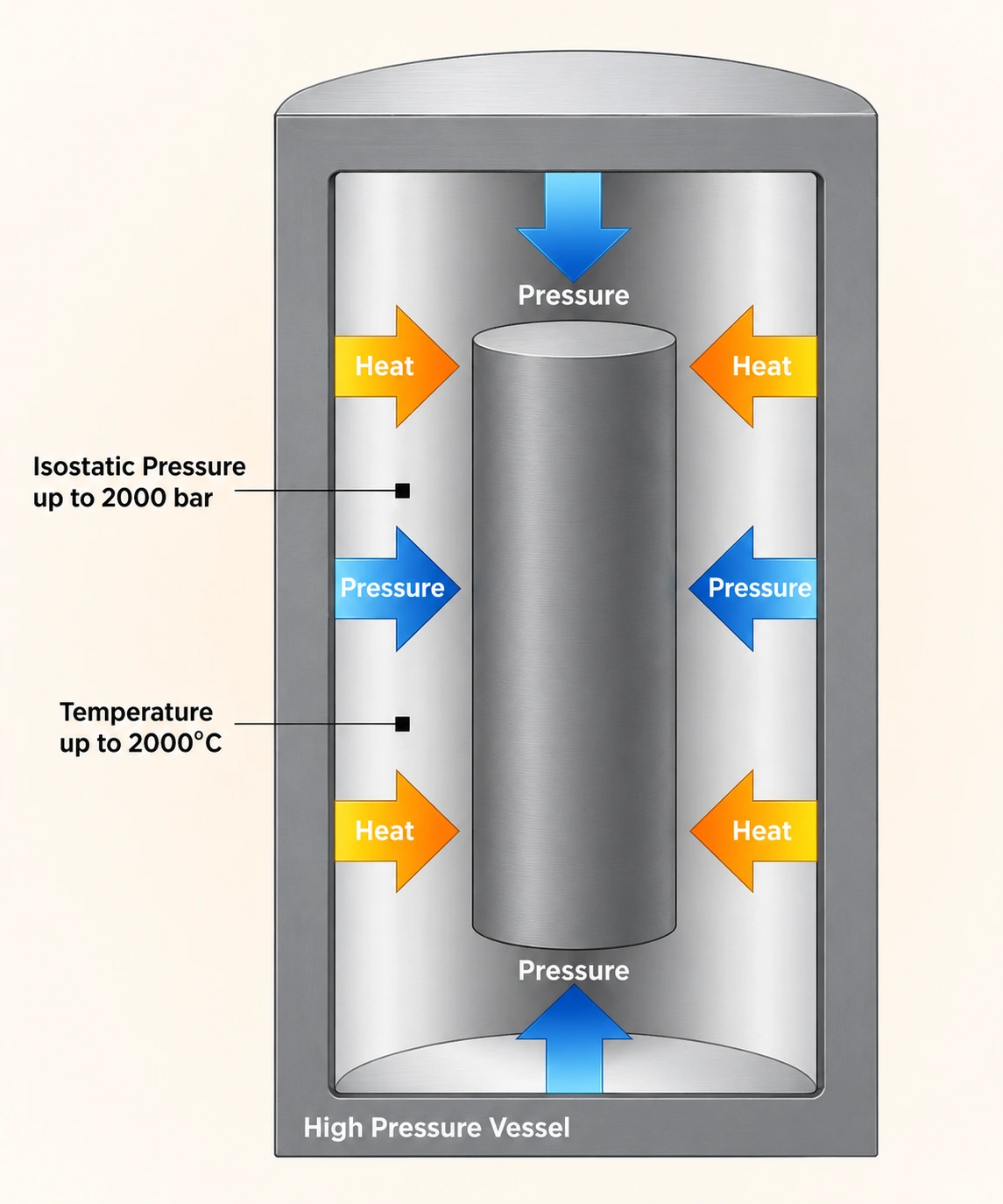
Hot isostatic pressing process diagram showing uniform heat and pressure applied to a metal component inside a high-pressure vessel.

How HIP Works: Simultaneous Heat & Isostatic Pressure

Unlike conventional heat treatment—which uses temperature alone in atmospheric or vacuum environments—Hot Isostatic Pressing combines extreme heat with uniform, multidirectional (isostatic) gas pressure:

  • Vessel Loading: Components are placed inside a high-pressure furnace vessel.
  • Vacuum & Pressurization: The chamber is evacuated and pressurized with high-purity Argon gas (pressures typically ranging from 15,000 to 30,000 psi / 100 to 200 MPa).
  • Thermal Processing: The furnace heats the chamber to elevated temperatures (typically 1,700°F to 2,200°F / 900°C to 1,200°C), softening the metal slightly.
  • Isostatic Densification: The massive gas pressure acts equally from all directions (isostatically) on the outer surfaces of the part. This immense force squeezes internal microscopic shrinkage voids, gas pores, and micro-cracks closed.
  • Diffusion Bonding: At high temperatures, atoms diffuse across the collapsed void surfaces, permanently plasticizing and bonding the internal walls together to restore a solid, continuous grain structure.

Technical Benefits: Why Specify HIP for Metal Components?

For high-stress, safety-critical metal parts, internal micro-porosity acts as a stress concentrator that initiates crack propagation and premature fatigue failure. HIP completely mitigates this risk:

  • 100% Theoretical Density: Eliminates internal micro-shrinkage and gas porosity in castings, achieving near-wrought density and mechanical soundness.
  • Massive Fatigue Life Improvement: By removing internal void-defect initiation sites, HIP increases the rotational and cyclic fatigue strength of cast components by up to 300% to 500%.
  • Restores Impact Toughness & Ductility: Significantly boosts elongation and impact resistance (Charpy toughness), bringing cast properties in line with forged standards.
  • Combines HIP & Heat Treatment (High Pressure Quenching): Modern HIP units utilize rapid cooling technology, allowing us to perform HIP densification and solution heat treatment in a single integrated furnace cycle, saving time and costs.
  • Reduces Scrap Rates & Radiographic Rejections: Cast parts that fail initial X-ray inspection due to internal shrinkage porosity can be "healed" through HIP, bringing them into 100% ASTM X-ray compliance.


Materials Processed with Hot Isostatic Pressing

ForceBeyond routinely processes high-value ferrous, non-ferrous, and superalloy material groups via HIP:

Material Category Key Alloys Processed Core Application Benefits
Nickel-Based Superalloys Inconel 718, Inconel 625, Hastelloy, Rene 41 Eliminates internal shrinkage in vacuum-cast turbine blades and industrial gas turbine volutes exposed to extreme thermal fatigue.
Titanium Alloys Ti-6Al-4V (Grade 5), Ti-6Al-4V ELI Critical for aerospace structural brackets and biocompatible medical implants (hip/knee joints) requiring high cyclic fatigue life.
Stainless & Duplex Steels 17-4 PH, 316L, Duplex 2205, Super Duplex 2507 Densifies high-pressure subsea valve bodies, pump impellers, and offshore fluid manifolds subjected to extreme hydraulic pressure.
Cobalt-Chrome Alloys CoCrMo (ASTM F75) Mandatory for medical orthopedic castings to ensure long-term biocompatibility and structural fatigue resistance inside the human body.
Aluminum Alloys A356, A357, 319 Densifies aerospace structural castings and automotive turbocharger housings, boosting tensile ductility and pressure tightness.

Tier-1.5 Integration: Cast, HIP, Machine & Inspect

Hot Isostatic Pressing is a key pillar of ForceBeyond’s Tier-1.5 Manufacturing Model. By combining primary investment casting with in-house secondary HIP and 5-axis CNC machining, we eliminate multi-vendor logistics and ensure defect-free compliance.

  • Investment / Vacuum Casting: The component is poured in our high-precision foundry.
  • Pre-HIP Inspection: Initial visual and Radiographic Testing (X-Ray) assessment.
  • HIP Densification: The part undergoes Hot Isostatic Pressing to eliminate internal porosity.
  • Post-HIP NDT Verification: 100% X-ray inspection (ASTM E192) and Fluorescent Penetrant Inspection (FPI) to verify total internal density and surface soundness.
  • Precision CNC Machining: Critical datum faces, bearing journals, and O-ring sealing grooves are machined to final sub-micron print tolerances.

Certified Hot Isostatic Pressing Applications

Our certified HIP processing serves the world's most demanding sectors:

  • Aerospace & Defense: Jet engine turbine blades, blisks, rocket propulsion nozzles, and Titanium airframe structural castings.
  • Medical Implants: Cobalt-chrome knee joints, titanium hip stems, and spinal fusion cages requiring zero internal defects.
  • Oil & Gas / Subsea: Super Duplex blowout preventer (BOP) components, subsea manifold trees, and high-pressure valve bodies.
  • Power Generation: Heavy-duty gas turbine impellers, nuclear reactor fluid fittings, and wind turbine hardware.

Frequently Asked Questions: Hot Isostatic Pressing (HIP)

Can Hot Isostatic Pressing (HIP) fix surface-breaking defects?

No. HIP requires an enclosed internal void to work. Because the pressurizing Argon gas fills any defect that connects to the surface, equal gas pressure enters the surface crack or pore, preventing it from collapsing. HIP only closes internal enclosed voids. For this reason, parts must not have surface-connected porosity during the HIP cycle (or must be clad/encapsulated).

Does HIP change the external dimensions or shape of the part?

Because the gas pressure applied is isostatic (equal from every direction), the overall external shape of the component is maintained. There is a microscopic overall volume shrinkage equal to the volume of the internal voids that were closed (typically less than 1% to 2% volume change for high-quality castings), but the relative geometric proportions remain identical.

How does HIP compare to wrought Forging?

Wrought forging uses mechanical dies to hammer or press a billet, which aligns grain flow and crushes voids to yield maximum fatigue strength. However, forging cannot create complex internal cavities or organic shapes. HIP takes a complex near-net-shape casting (which can have internal cavities) and applies gas pressure to eliminate its internal voids—yielding mechanical properties and fatigue performance that rival a forging, while retaining the complex design freedom of a casting.

Sources

Our Internal Resources for Die Casting, Investment casting, Forging and Sand Casting